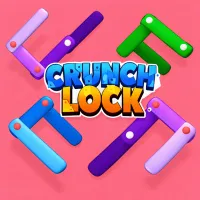
Crunch Lock is a logic-based puzzle game centered around untangling colorful ruler-like segments that overlap on the screen. Each piece is connected to a pivot point, and the objective is to rotate or unfold every segment until the board is completely cleared. What looks simple at first quickly becomes layered and strategic. The challenge comes from understanding how each piece interacts with the others.
How to play Crunch Lock
Every segment rotates around a fixed hinge when clicked or tapped. However, pieces cannot move freely if their circular path is blocked by another segment. This creates a “lock” effect where certain rulers remain stuck until surrounding pieces are cleared. Success depends on freeing segments in the correct order rather than moving randomly.
Strategic Tips for Solving Levels
Work From Outside In: Start with pieces that have nothing resting on top of them, as they are usually free to move.
Use Trial and Error: There is typically no heavy penalty for mistakes, so testing movement options helps identify blocked paths.
Visualize the Rotation Path: Before clicking, imagine the arc the piece will travel; if another segment intersects that path, it must be cleared first.
These techniques make complex layouts easier to decode.
Why Crunch Lock Feels Addictive
Crunch Lock keeps players engaged by combining simple controls with layered logic. Each solved board delivers a satisfying sense of order and clarity. The gradual increase in overlap complexity keeps puzzles challenging without introducing unnecessary mechanics. It is easy to learn, but increasingly rewarding as levels grow more intricate.